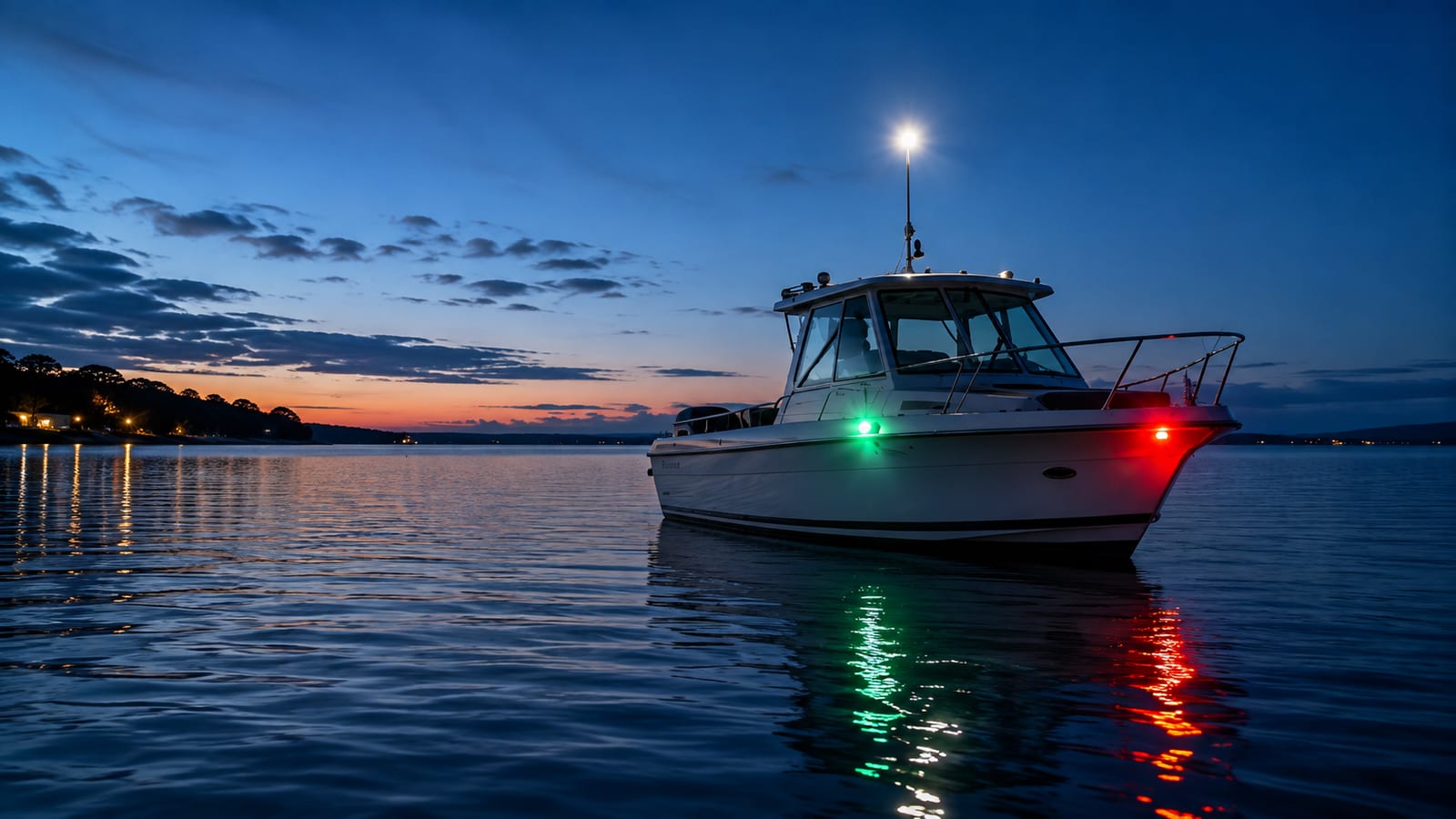
At night or in poor visibility you can only recognize other vessels by their lights – and you have to read from the light configuration what kind of vessel it is, where it’s heading, and whether it might be restricted in maneuvering. Navigation lights are a core topic of the SBF See theory, and picture questions on this topic regularly trip up candidates in the exam. Here’s the overview, including the famous memory rhymes.
The Basic Lights and Their Arcs
Each navigation light shines only over a specific arc of the horizon – which tells you from what direction you see it:
- Masthead light: white light, 225°, shines forward (across both sides to abeam-aft).
- Sternlight: white light, 135°, shines aft (behind).
- Sidelights: 112.5° each – green to starboard (right), red to port (left).
- All-round light: white (or colored) light, 360°, visible all around.
Together, the masthead light (225°) and sternlight (135°) add up to exactly 360° – so the boat is visible from every direction.
Power-Driven Vessel Underway
A power-driven vessel (motorboat) underway shows:
- Masthead light (forward, white)
- Sidelights (green/red)
- Sternlight (aft, white)
Small power-driven vessels under 12 m may combine the masthead and sternlight into a single white all-round light – plus sidelights. Vessels of 50 m or more carry a second, higher masthead light.
How to tell the heading: if you see both sidelights (red and green) plus the masthead light, the boat is heading straight toward you. If you only see the white sternlight, it’s heading away from you.
Sailing Vessel Underway
A sailing vessel under sail (no engine) shows:
- Sidelights (green/red)
- Sternlight (white)
- No masthead light!
The missing masthead light is the decisive feature: if at night you see sidelights but no masthead light, there’s a sailing boat ahead. Optionally, a sailing vessel may also carry two all-round lights at the masthead: red over green.
Important: as soon as a sailing boat switches on the engine, it counts as a power-driven vessel and must show the masthead light (by day, the black cone, point down).
Small Vessels and Rowing Boats
- Power-driven vessels under 7 m with a maximum of 7 kn: at least a white all-round light (ideally sidelights too).
- Rowing and sailing boats under 7 m: at least a white lamp (e.g. a torch) shown in time to avoid a collision.
Special Lights – The Memory Rhymes
Certain vessels carry additional all-round lights that tell you their status. The classic mnemonics help:
- Red over red – the captain is dead: two red all-round lights, one above the other = not under command (e.g. engine failure).
- Red – white – red: three all-round lights (red-white-red, vertical) = restricted in ability to maneuver (e.g. towing, dredging). A towing convoy carries its own extra lights on the tug and, where relevant, on the tow – see Towing Convoys and Special Vessels for the details.
- Green over white – fishing at night: a trawler at work.
- Red over white – fishing without trawl: a fishing vessel not engaged in trawling (COLREG Rule 26c).
- White over red – pilot in sight: a pilot vessel (COLREG Rule 29a).
At Anchor
A vessel at anchor under 50 m in length shows a single white all-round light (anchor light) wherever it can best be seen. Larger vessels (50 m and over) carry two – one forward, one aft, the forward one higher. So at night you recognize an anchored ship by a single white all-round light without running lights (COLREG Rule 30).
Visibility Range of the Lights
Color and arc aren’t the only things that matter – the minimum visibility range is exam material too (COLREG Rule 22). For recreational boats under 12 m in length:
- Masthead light: at least 2 nautical miles
- Sidelights: at least 1 nautical mile
- Sternlight: at least 2 nautical miles
- White, red, green, or yellow all-round light: at least 2 nautical miles
From 12 m upward the requirements increase: the masthead light must then be visible for 3 or 5 nautical miles depending on vessel size, and sidelights for at least 2 nautical miles. For the SBF exam, the values for boats under 12 m are usually what you need, since most recreational boats fall into that category.
How to Learn Navigation Lights
- First the basic lights (masthead, sidelights, sternlight) and their arcs.
- Then the distinction between motor and sail via the masthead light.
- Finally the special lights with the memory rhymes.
- Practice with images: exam questions show light combinations – train recognizing them from the viewing angle.
Conclusion
Navigation lights can be derived from a few building blocks: masthead light (225°, forward), sidelights (green/red, 112.5° each) and sternlight (135°, aft). The masthead light distinguishes motor from sail, the minimum visibility ranges are fixed exam material, and the rhymes (“red over red – the captain is dead”) help with the special lights. Once these building blocks are second nature, you’ll also recognize unfamiliar light combinations reliably in the exam. To see how this knowledge applies on an actual night passage, check out the companion article.
The Boatpass app gives you the typical exam images straight from the official ELWIS question catalog, lets you practice them in exam mode under realistic conditions, and shows you right away which light combinations still trip you up.