
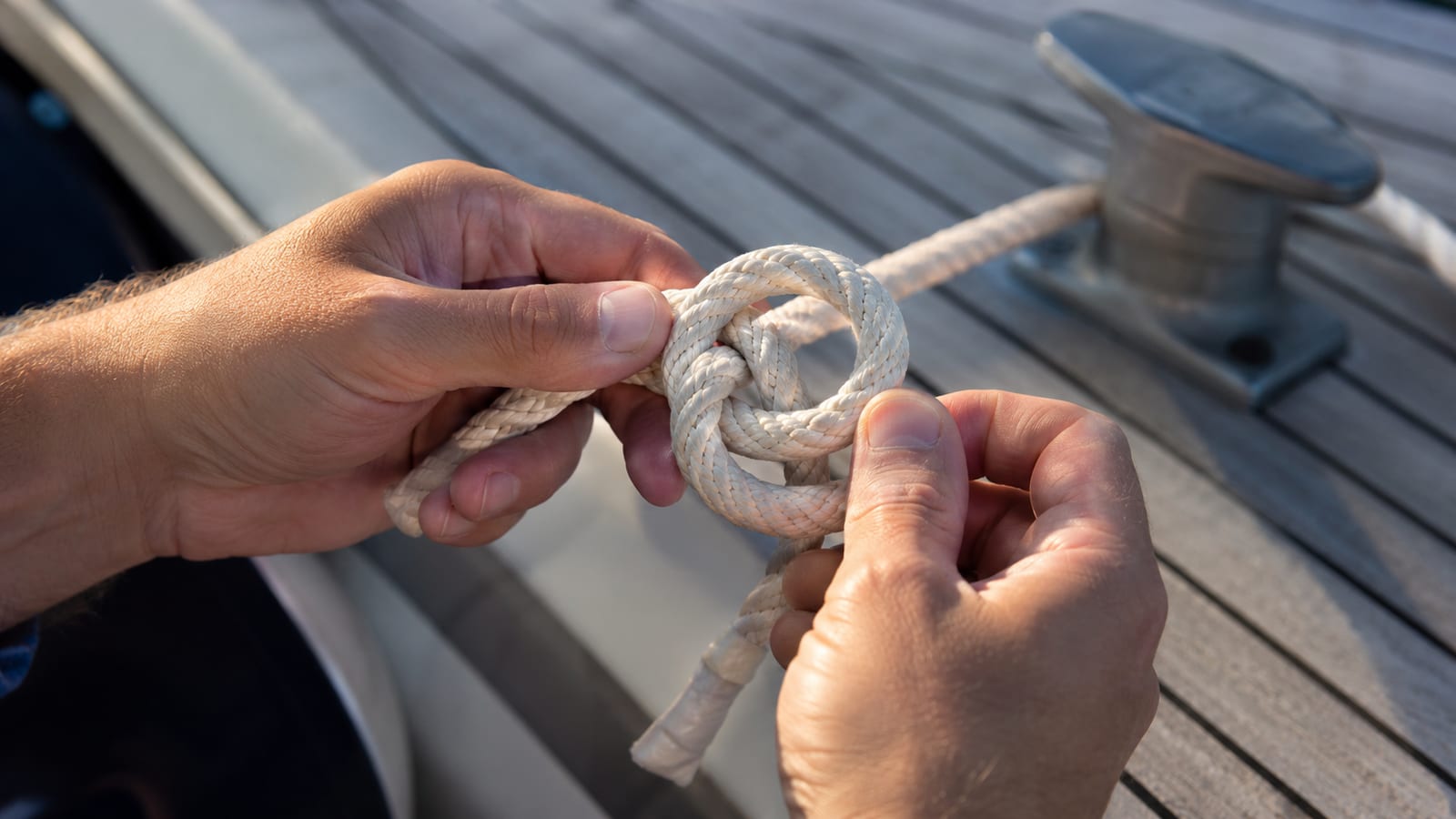
For many, the knots are the part of the practical exam with the biggest “aha” moment – and the one that’s most easily underestimated. In the practical exam for the Sportbootführerschein See you must not only tie seamanship knots but also explain their purpose. Here’s an overview of every exam-relevant knot and how to master it.
How Many Knots Do You Need?
In the SBF See practical exam, you’re tested on a list of nine knots. You generally have to demonstrate at least six of them correctly and explain what each knot is used for. The SBF Binnen practical (engine) also includes cleating a line and basic knots.
The examiner names the knot – you tie it and state its purpose. Speed is secondary; what matters is that the knot is correct and that you know its function.
The Nine Exam-Relevant Knots
1. Figure-Eight Knot
The figure-eight is a stopper knot. It prevents a line from slipping through a block or eye. It’s quick to tie and can be undone even under load.
Use: as an end knot on a line so it doesn’t run out.
2. Reef Knot (Square Knot)
The reef knot joins two lines of equal thickness. Important: both ends must be passed cleanly “right over left, then left over right” – otherwise you get an unsafe granny knot.
Use: joining two lines of the same diameter, e.g. when reefing.
3. Clove Hitch
The clove hitch is a quickly made fastening to a bollard, post or rail. It holds well under steady load but should be secured.
Use: making fast to a post, attaching fenders.
4. Clove Hitch on Slip
The “on slip” version can be released quickly by pulling the loose end – handy when the knot only needs to hold briefly.
Use: quick, releasable attachment, e.g. of fenders.
5. Round Turn and Two Half Hitches
A very secure fastening: a full turn around the bollard takes the load, two half hitches secure the end. It holds even under changing load.
Use: making fast to a bollard or ring, even in current and wind.
6. Rolling Hitch (Stopperstek)
With the rolling hitch you attach a thinner line to a thicker line under tension – it grips through friction.
Use: load relief, e.g. temporarily taking over a loaded line.
7. Bowline
The bowline is the most important knot on board. It forms a fixed, non-tightening loop and can be undone even after heavy load. “The rabbit comes out of the hole, around the tree, and back down the hole” is the classic memory aid.
Use: a fixed loop, e.g. for making fast over a bollard or as a rescue loop.
8. Sheet Bend
The sheet bend joins two lines of different thickness – where the reef knot would fail. The double sheet bend holds even more securely.
Use: joining two lines of different diameter.
9. Cleating a Line (Cleat Hitch)
Cleating a line is mandatory: the line is led in a figure eight around the cleat and secured with a locking turn. Done wrong, the line slips or jams.
Use: making the line fast to a cleat on the boat or dock.
Practice Tips
Practice With a Real Line
You don’t learn knots by watching but through repetition with your hands. Get a piece of rope (about 1.5 m) and practice each knot until it sits “blind.”
Learn the Purpose Too
In the exam, tying isn’t enough – you must state the purpose. Always learn the knot and its use as a pair.
Short Daily Sessions
Five minutes a day beats one long session before the exam. Knots are pure practice and stick quickly if you keep at it.
Conclusion
For the SBF See practical you must tie at least six of nine knots reliably and explain their purpose – the bowline, the round turn with two half hitches, and cleating a line are among the most important. With a piece of rope and a few minutes a day you’ll have them down quickly. While you practice the hands-on part, you can train the theory in parallel in the Boatpass app with the official ELWIS question catalog – so you’re ready for both parts of the exam.